The Iraqi Jewish community, the oldest such community
outside of Israel, has a
history spanning over 2,600 years. Hundreds of years
before the 7th century Muslim occupation, Jewish communities had
existed in this region. The Jews shared the Arab culture with their Muslim and
Christian neighbors, but they lived in separate communities. Jewish
assimilation into Muslim society was rare.Under centuries of Islamic rule Jews were classified as
dhimmis (‘second class citizens’). The crumbling Ottoman Empire gave them more
equality. By 1884, 30,000 Jews lived in Baghdad. By 1900, the number had risen
to 50,000, with Jews representing over a quarter of the city’s total
population.
Brittain ‘created’ Iraq after WWI (Jordan is also a similar British 'invention'.) The modern, secular and almost
democratic state became independent 1932.
Iraqi Jews worked as lawyers, musicians, economists, accountants,
academics, artists, and intellectuals. The fact that numerous Jews held key
positions in public office, was resented by their Muslim compatriots.
In the 1940s about 135,000 Jews lived in Iraq (nearly 3
percent of the total population), with about 90,000 in Baghdad, 10,000 in
Basra, and the remainder scattered throughout many small towns and villages.
In 1933, Germany acquired Iraqi Christian newspaper Al-Alam
Al-Araby (The Arab World) and began publishing a serialized Arabic translation
of Adolf Hitler’s Mein Kampf. In 1939, Mufti Haj Amin al-Husseini of Jerusalem fled
Palestine disguised as a woman. The Kingdom of Iraq welcomed him with gifts and
money. His pro-Nazi propaganda and violent radio incitement against Jews resulted
in racial Jewish laws, mass dismissal from public posts, discrimination and
harassment in the streets.
On April 19, 1941, Britain declared war and tried to regain
control of the region by occupying Basra. This resulted in widespread looting of many Jewish owned
bazaar shops. Arab night watchmen protected Jewish possessions and many Moslems
protected Jews in their homes.
During this time, four Iraqi officers, known as the “Golden
Square,” carried out a coup to install Rashid A. al-Gaylani, a strident
supporter of the Axis powers, as prime minister.
In the last week of May 1941, in Bagdad, Jewish homes were marked
with a red palm print ("Hamsa"). They were instructed to pack
suitcases and to wait to be taken to "detention camps for their own
safety". May 30, Rabbi Sasson
Khaduri, the community leader, was told that, as a ‘protective‘ measure, the Jews
were to stay home for the next three days. Plans for a larger massacre failed
when the self-proclaimed governor was forced to flee the country.
When the military coup failed, Gaylani fled to Berlin, where
Hitler warmly received him. Radio Baghdad announced exiled members of the royal
family were returning very soon. British and Transjordanian forces were
surrounding the capital and it was only a matter of days before they restored
law and order. The relieved Jewish community thought it was safe to
celebrate Shavuot.
On June 1st, as they left synagogue on the eve of
the Shavuot festival, a crowd awaited them with batons, daggers and swords.
Many
of the Jewish houses and shops marked with the red Hamsa were ransacked and entire
families were murdered by the mob. Jews trying to escape were pulled out of the
vehicles and slaughtered. Synagogue windows were smashed, Torah scrolls
desecrated, crazed mobs chased Jews with daggers and swords. Students and armed
police joined the massacre. Survivors testified of policemen breaking into
houses and slaughtering Jews, cutting off limbs and looting jewelry. Men had
their genitals cut off and stuffed in their mouths. Women were raped and had
their bellies slashed while still alive. Children were thrown into the river
and wells. People were thrown off rooftops and the crazed mob delighted in
hearing the cries of the stricken and tormented Jews.
What became known as the Farhud pogrom lasted for two days
when Iraqi troops finally restored order. Throughout the onslaught, British
troops, who were on the outskirts of the city, didn’t lift a finger to help.
The highest death toll was amongst Jews living in self-segregated
areas. Many of those living in mixed Muslim-Jewish neighborhoods survived because
of the bravery of their Muslim neighbors who protected them.
Mordechai Ben-Porat, a Jew who later served as an Israeli
government minister, described his experiences:
“We were mostly cut off from the center of the Jewish
community ... It was because of one Muslim neighbor that we survived the
Farhud. We had no weapons to defend ourselves and were utterly helpless. We put
furniture up against the doors and windows to prevent the rioters from breaking
in.... For two days, the streets flowed with blood. The cries of the Jews were
heard all over the city ... and finally bodies piled up in a huge mass grave.
As well as Jews being killed and wounded, many hundreds of Jewish-owned
properties were destroyed with around 1,500 homes and stores broken into,
ransacked, and set ablaze. Damages to property were estimated at some $3
million (US$ 51 million in 2019).
The Farhud triggered the mass emigration of Iraqi Jews.
Through
the clandestine underground immigration movement, some 120,000 people – 90
percent of Iraq's Jews were brought to the young Jewish State through Operation
Ezra and Nehemiah (1950 and 1952). Today, fewer than ten Jews remain in the
country.
On the eve of Yom Kippur 1946, members of the “Babylonians” –
an Iraqi youth group- settled in Nahabir.
Shortly after breaking ground, the
Zionist government asked some of the “Babylonians” to return to Iraq to prepare
additional young men and women to make Aliyah. Kibbutz Be’eri, established a
few miles west of today’s location, was part of the “11 points plan”.
Yaakov Tzemach, member of the Baghdad HeChalutz youth
movement was trained by the “Babylonians”.
Later, after joining the IDF, Yaakov was part of the Israeli
army’s Nahal agricultural settlement program, which sent a group to help
strengthen Kibbutz Be’eri in the early 1950s.
Every Shavuot eve, Yaakov Tzemach would tell his family and
Kibbutz Be’eri members the story of the 1941 Farhud pogrom. Yaakov’s family
too, survived the massacre thanks to an older Muslim woman who physically
blocked the way to their house and prevented the rioters from entering.
The cooking in the Kibbutz kitchen was also influenced by the Iraqi
immigrants: “Even the gefilte fish was done in Mizrahi style.” Iraqi born Avraham
Dvori (Manchar) was eight years old when he arrived at the kibbutz, where
everyone spoke Hebrew. “I entirely forgot the Arabic I knew from home,” he
said. His family of five children and 15 grandchildren also live in Beeri. “We
have members from over 30 countries of origin. Everyone is mixed with everyone
- this is the Land of Israel for me. This is what gives the kibbutz a sense of
warmth.”
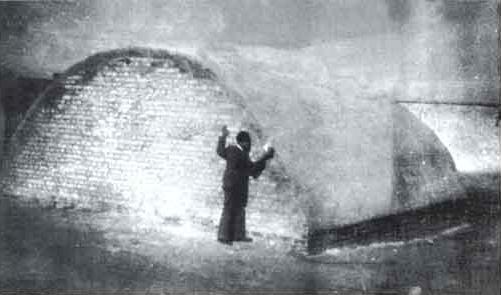
After the Farhud, the Jewish community set up a monument in
Bagdad’s Jewish cemetery to mark the location of a mass grave.

This monument
was later destroyed by the Iraqi government.
A replica of this monument was set
up nearby the Be’eri forest.
On October 7, this forest was used by Hamas
terrorists as a staging area before moving to attack Be’eri and other nearby
communities.
That Simchat Torah, Yaakov’s grandson, Shachar, was part of
Be’eri’s civilian emergency defense squad. He took part in a heroic and
desperate defensive battle for many hours, before he was eventually killed.
Yaakov Tzemach ob”m (right), survivor of the Farhud, Shachar
Tzemach ob”m (center) killed on October 7, with one of the family girls in his
lap, and Doron Tzemach (left), member of Kibbutz Be’eri. From a family album.
“We made Aliyah from Iraq to Israel so that Arabs wouldn't
be able to enter Jewish homes and murder us.”
Eighty two years later, the Farhud had returned to Be’eri.
Monument "Prayer" in Ramat Gan in memory of the Jews who were killed in Iraq in the Pogrom "Farhud" (1941) and in the 1960s
********************************
Article research/sources: